Friday, 15 November 2013

XL. The Box

A little digression. Look, a box with my mark on the lid. What could it hold inside?


Parallel with the mandrake form the last post, I worked on a wee diorama unconnected to the Gardens of Hecate project. The idea was for it to be very small and easy to carry around, so I can always have it with me in my bag to show it to people when the question "So, do you have any hobbies?" comes up. I find it excruciating when I have to describe this obscure hobby to someone who's never heard of anything like it, and most of the time I can't tell if they even got the idea in the end. Having an example to show them would make it so much easier for me.

For that reason I came up with this scheme of building a diorama inside a tiny box. It took me some more time to figure out what kind of scene I would be doing in the first place. After tossing around a couple of ideas, I settled for an image from one of my own original tales: the story of the demon critter Krastačar.

He's an impish creature with the skin of a frog, a rat's tail and a long nose. In the story he causes some trouble to the village of Vranobor. The tale also mentions that he often visitis the great forest Rogorija, where he enjoys one of his favourite pastimes: he catches "squirrels, rats and mice and then ties all their tails together in one big knot."- a reference to the rat king phenomenon. I reckoned the diorama could show him chasing a mouse through the forest, since that's nicely dynamic and I already had a miniature rodent and a nurgling in a convenient pose to represent the imp.

Enough rambling, here it is- the pocket diorama:

The inside. In the lid I pasted a piece of yellowed paper with some of the actual text of the story, and a stylized toad painted on top of it. Krastačar hatched from an egg of a toad. His father was a three-legged rat...
The diorama itself is 30mm wide, 45mm tall, and just a bit over 20mm deep. And it's basically a 3D illustration. : )
Here in the background is a map of the story, which I made to be able to refresh my memory right before telling it.
.
Hope you like it!


 *  *  *


Monday, 11 November 2013

XXXIX. The Root of Mandragora

Mandrake - Mandragora officinarum (Solanaceae)- is a Mediterranean plant which, just like many of its fellow nightshades, contains potent alkaloids. It has greenish-white flowers and brownish-orange berries (the only non-poisonous part of the plant), and its branched root resembles a tiny human figure. 

The Solanaceae/ nightshades family contains some other interesting plants. Deadly nightshade (Atropa belladonna) has a long history of use in medicine ( most notably as a painkiller), cosmetics (historically, women used drops prepared from the plant to dilate their pupils, which was found attractive; that's where the name comes from: bella donna is Italian for pretty lady.), as well as a poison and a recreational drug (it causes vivid hallucinations, but it's quite risky because it's easy to accidentally fatally overdose.). 
Datura (Datura stramonium) has uses in medicine, shamanism and, according to Wade Davis' controversial hypothesis, it is an important ingredient of a powder used by Haitian voodoo witch doctors to turn people into zombies.
Henbane (Hyoscyamus niger) as well is used as an anaesthetic, a psychoactive drug and poison. Henbane might be the cursed hebenon, whose juice was used to kill Hamlet's father. 
Nicotiana tabacum, commonly known as tobacco plant, contains the alkaloid nicotine, which is a neurotoxin and was long used as an insecticide. In mammals, though, it acts as a stimulant, which is why I enjoy it on a daily basis. 
Plants like tomato, potato, pepper and eggplant also belong to the nightshade family, but are far more fun to eat than to write about.
Let's go back to mandrake.


With its interesting root and its hallucinogenic properties, it's only natural that quite a bit of folklore has grown around mandrake. A mundane and perfectly real plant species transformed into a mythical creature. So what does folklore say? 

First of all, the shape of its root is by no means a coincidence- every mandragora is fathered by a human. More accurately, it grows where the semen of a hanged man dripped on the ground (this is not that rare an occurrence, and it's called death erection). It makes sense, of course. It looks like a man because its father is a man. Its mother is the earth, and the earth normally gives birth to plants when seed is planted in it, so mandrake is a plant as well. 

That also might be the reason why it is said to scream when it is taken out of the ground- a human newborn screams when it comes into the world. But why is the scream of a mandrake deadly to all who hear it?
It IS a highly toxic plant, could be deadly if you ingest it. Perhaps people just extended that deadliness to its voice. That reminds me of a similar thing with the basilisk: its bite is deadly (it must be, after all it's the king of serpents), but for some reason its gaze kills just as well. I have another theory, though.

If people believe that picking a mandragora will kill them, they won't go around picking them. And if they never pick it they won't find out it doesn't have a killer scream, so the legend lives on. But who the hell cares? Well...  

People believed the root was a very useful thing to have, like a lucky charm. Here's a quote from the book Folk Medicine (Brenko,Dugac,Randić. 2011. Narodna medicina. Etnografski muzej Zagreb.):
"Mandrake (Mandragora officinarum Tourn.) was one of the most famous magic and poisonous plants in the Middle Ages, which became a symbol of this period. The root was cut in the shape of the human body and kept as an amulet. It brought good fortune only to the owner who would weekly bathe it in wine, clothe it in a silk or velvet robe, and offer it the finest food." 
The possession of it was thought to ensure prosperity. But everyone knows that one can't just go and pick it, if they wish to live. The best thing to do then is buy it from a professional who is skillful at digging up mandrakes. So, who profits from people's continuous belief in the deadly scream? Mandrake salesmen. Pretty cool scheme. And as it says in the quote, the root was often additionally cut, to better resemble the human form. Sometimes the root was not even mandrake at all, but some other root cut into the desired shape.

Artwork by Santiago Caruso. An old hag appears to be pampering a mandragora. It's wearing a tiny outfit, and there's a tank full of red liquid on the side (wine? blood?), presumably for the root's bath.
   According to folklore, there is a way to safely take a mandrake out of the ground, but I'm saving that bit for a later post.

Now, I present the Running Mandragora:


Funny little bugger. The base is one of the Nurglings from the Plaguebearer box. I erased its face and clipped its horns. The leaves are made of greenstuff, using a homemade press mould to achieve the veins. The white berries are grains of sand. 
The real life plant is of course not red, I took some artistic liberty here. I'm happy with how it turned out. : )

Mandrake getting chased through the woods by a pack of bloodfiends.

Same as above, but desaturated. Which one looks better to you? This is a bit of practice for the future battle report pictures.

This one is with blur, for a better sense of motion.

Thursday, 7 November 2013

XXXVIII. Another November

My, my, time flies. Almost a week ago, on November 1st, it had been exactly one year since my first post in Gardens of Hecate. In that time I have converted and painted 44 miniatures and built around twenty pieces of various terrain, displayed across 38 blog posts. I still haven't played a single game; but hey, all in good time. Thanks to all folks who follow and comment on my blog, be you among the 63 registered ones or one of them lurkers. Big thanks to Dave Taylor for featuring Gardens of Hecate in his own blog; as that really helped people notice this place.
Anyways, happy birthday Gardens!  : ) 


A peek into my display cabinet, where the Gardens collection currently takes up two shelves.


*  *  *
Wyrd's Rotten Harvest online painting competition is running a bit late, they suddenly moved the deadline for a few days. But the galleries are now finally up: Rotten Harvest 2013 Galleries. I'm not allowed to say which entries are mine until after the voting has ended on Nov 17th, but if you go through the Not Quite Dead Yet category it shouldn't be that difficult to guess one. The polls should be up on Wyrd forum sometime today, so if you're registered there- do cast a vote for your favourites.


*  *  *

What's next? A bit of walking plantlife; namely, a mandragora and a tree-man. Both are meant for scenarios I'm working on, but more on that later.

My mandragora is still a sketch. There will be three versions of it: buried, uprooted and dead. I'll make the uprooted, running one out of a spare Nurgling, and the other two will be completely scratchbuilt.

The tree-man is an Ent from GW's LOTR range. It used to have a face, but I removed it and added some branches to the front of its head. In a scenario, it will be the guardian of a powerful magical item.

Thursday, 24 October 2013

XXVII. Hodgepodge

Some miscellaneous things to share today. I'll start with a few pieces of inspiring artwork:

by Francesco Balsamo

by Francesco Balsamo

by Haruko Maeda

by Zdislaw Beksinski;
I love this painting, even more because it bears an eerie resemblance to my Custodian spirits.

by Zdislaw Beksinski
If you're a fan of Beksinski, YouTube channel Droog's Mixes has this video which combines Beksinski's amazing artwork with a very appropriate soundtrack of dark ambient music. And there's an entire hour of it. Delicious.


If you're on Facebook and like macabre and beautifully grotesque art, you'll enjoy the page The Macabre And the Beautifully Grotesque. It collects tons and tons of freaky artwork.

*  *  *

The other day I chanced upon an interesting four-part video series Everything is a Remix. It discusses how ideas evolve, the derivative nature of creativity, and the problems which occur when the law system decides to treat ideas as property. You can watch the entire series here: Link.

*  *  *

I knocked together this bell some time ago, but never posted it here. People use it to proclaim an emergency, to summon meetings and similar. It comes from VC Corpse Cart kit.


I bought another Citadel Wood kit. I'll use the forest's base to make a small graveyard, and the trees will stand on their own. I also have a half- made mushroom ring on a CD base. Can't wait to go back to terrain-making in November. : )

Monday, 7 October 2013

XXXVI. Custodian Spirit III.

Made another Custodian. This time I cut up a plastic Banshee I had lying around.


It's cool how many different miniatures I can use to make these. So, the three Custodians all vary in size and detail. This one is the smallest and a bit more fancy. It was probably a lady, back when it was alive. 


On a different note: looks like October will be a pretty slow month here in the Gardens.

I'm working on two new crews for "proper" Malifaux's second edition. If you're interested you can follow my progress on Carrion&Hodgepodge. The plan is to have all 15-ish minis done by mid November.

Another thing that's occupying my time is Wyrd's Rotten Harvest online painting contest. The rules say I'm not allowed to say what it's gonna be, or show any WIP photos or concept sketches. The deadline is October 31st. I'm converting like crazy already. Wish me luck.

Sunday, 29 September 2013

XXXV. Vermin!

Rats


I figured the Gardens needed some plague-carrying rats to skitter around, so I  painted up these:


It felt they would look weird on 30mm lipped bases, so I put them on plain 25mm ones. It works. I have more of them waiting to be painted. In the end I'll have about 20; all various GW plastic rats. They could be useful for different scenarios.

Rat King


Rat king is a rare phenomenon: a number of rats somehow become interwined at their tails, which also get stuck together with stuff such as dirt, ice, excrement or blood. Rat kings were often considered a bad omen, especially of plague.

Mummified rat king, kept in the scientific museum Mauritianum in Altenburg, Germany. It was discovered in 1828 in a miller's fireplace.

I think rat kings are pretty cool, so I wanted a miniature rat king. I can see the Plague Doctor or the Countess attempting to kill it for its magical properties and/or because of its association with plague, while it continuouisly spawns swarms of rats to defend itself. I kind of imagine it not as a group of rats, but as a single multi-bodied entity.
Anyway, here it is. I put it on a 40mm base. It consists of 8 little rats from the Skaven Abomination kit, and some thin wire for the tail knot in the centre.


Thursday, 19 September 2013

XXXIV. Artwork

Unfortuantely I' m too busy with other stuff to be working on new GoH miniatures at the moment, but I found a bit of time to scan my latest attempts at stat card artwork. 

Crimson Sphynx. I pretty much ripped off the pose from Santiago Caruso's artwork which was the inspiration for the model in the first place.

Ravenous Bloodfiend. I took a lot of liberty with that one. It's as if the artist who painted it never really encountered this spirit, but rather imagined it from accounts of those who had seen it.

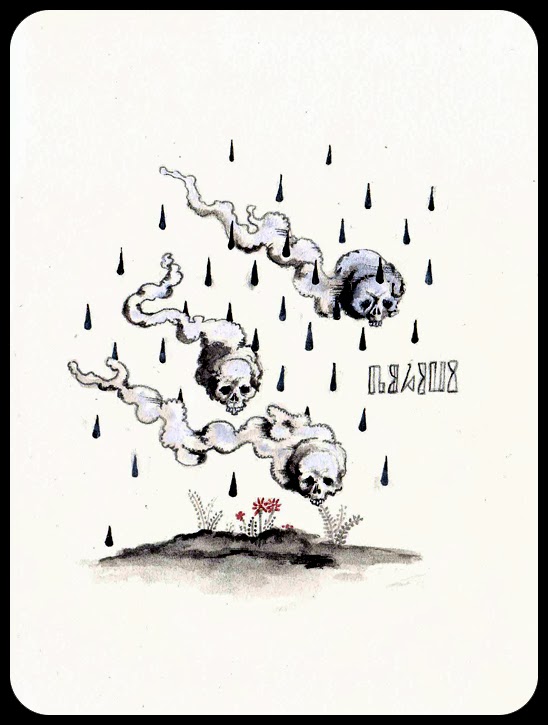
Gheists. To avoid it looking dull I depicted not one but three of them, and added the "rain drops" to fill up the space.

The Plague Doctor. Done in a different style than the others, and on different kind of paper.

*   *   *


Tuesday, 3 September 2013

XXXIII. Making Terrain III

The large Hanging Tree stood half-painted on my desk for a while. So I used my study-breaks throughout the last couple of days to finish it. 

Mushrooms!

The base is a CD covered with a layer of clay.

Three more wooden fences done:


And this little road sign. I painted the bird  to represent a hooded crow, which is the most common kind of crow in my parts. It's got a grey body with a black head, wings and tail.


Let's see what we've got so far:
  • 1 Citadel Wood
  • 2 Hanging Trees
  • 1 large Hanging Tree
  • 7 wooden fences
  • 1 large house
  • 1 chapel
  • 3 barrels
  • 1 crucifix
  • 1 road sign.

Not bad, I'd say. That's all from me for today, now it's back to studying.

Saturday, 31 August 2013

Wednesday, 28 August 2013

XXXI. Noise. Horns. Underworld.

I'm back and it's time to present the newest set of minis I'll be making. There were originally two ideas I had to choose between, both involving grotesque creatures that emerged from underneath the earth:

I. HOMO TROGLODYTES


Stray branch of humankind. Deformed inbred creeps who normally live deep in subterranean caves and have no dealings with the world above the ground. However, for some reason they have now emerged from the darkness and started attacking their Homo sapiens relatives. Their leader is the huge levitating Mother, the one they all descended from. 

The main inspiration for the concept were the Wendol from The 13th Warrior / Eaters of the Dead. And possibly ants, a bit.

The faction would consist mainly of a horde of misshapen Troglodytes (The Hobbit Goblin Warriors are perfect for the role; no converting needed and you get close to 20 in a box), perhaps a shaman of some kind, and the Mother- a scratchbuilt monstrosity in the image of the most famous piece of Paleolithic art: the Venus of Willendorf. 


II. THE ANCESTORAL FLOCKS


The heathen ancestors who emerged from the underworld in these terrible times to drag their descendants back down with them. Flocks of beast-headed revenants hung with big noisy bells, led by the Four Horse-men of Hades.

Their design based on figures from Croatian traditional carnivals (note that very similar costumes appear all across Europe which almost certainly means they are related), the faction would include a number of beast-headed bell-ringing footsoldiers, Grandfather and Grandmother, a hobby horse, possibly a devil and a bear with handler...
Most of the characters can be made from a box of Nurgle Plaguebearers. And I already have Confrontation Scavengers of Acheron for the remaining three Horse-men.  

I decided to go with option #2 because it seems more interesting- it involves a lot of design and sculpting. That doesn't mean the troglodytes won't get made. They'll just have to wait for their turn.

*  *  *

So, having made up my mind I proceeded to make my first footsoldier revenant. 


THE INSPIRATION


Zvončari, nap'hanci, buše, didi... the inspiration came from them. Ever since I first saw them as a little girl, I've been fascinated by the horrific carnival bell-ringers. They are groups of men, their faces typically covered with grotesque horned masks and their torsos with fleece or animal pelts, who wear large bells hung from their bodies. In their hands they usually carry clubs, sticks or similar instruments. They move as a scary noisy horde, sometimes chasing innocent bystanders around and smearing their faces with char or throwing them into deep snow.

Nap'hanci as a museum exhibit.

Nap'hanci in their "natural habitat", accompanied by a crude hobby horse.
According to scholars the bell ringers are of dual nature. On one hand they are seen as ancestoral figures, which is supported by some of their names, the fact they are accompanied by grandfather and grandmother figures, as well as their terrifying appearance and behavior which points to apotropaeic magic. 

Nap'hanec with a pitchfork.

On the other hand, their acts, such as hitting people with ash-filled stockings, dances and songs for better crops, clubs they wield (phalic symbol, possibly) and obscene jokes performed by characters which accompany them all point to a form of fertility magic.

Zvončar, his face revealed. In his right hand he's holding his headgear and in the left an ash-filled stocking. Around 1930.
Zvončar's back; note the bigass bells. Around 1930.
I actually found etnographic footage of zvončari from 1931:


THE DESIGN


I've shown a bit of this months ago, actually:


What I wanted to do here was make the creatures the traditional costumes represent come to life. I want them to look rotten since they are a sort of undead. The word nap'hanec actually means something like swolen/bloated/blown up one, and the clothing of that costume is filled up with straw. It's pretty cool then that the Plaguebearer sculpts have that bloated belly and weird bulges all over the place. 

The different types of scary headgear are to be translated into actual scary heads.  One or more bells of some sort is a must. The weapons are be clubs, scythes, sickles, pitchforks. Details such as parts of their skulls visible, ropes and sacks will appear throughout the faction (they can be found on first Horse-man as well). As for the paintjob I intend to have them in different shades of sickly green and grey/off white, with black fur. 


THE MINIATURE


And finally, after all this rambling, the actual miniature. The fellow is still a WIP, but you can get the idea. Apart from the horns, which come from Goblin King's sceptre, I sculpted the entire head myself. The weapon is from Skaven Clanrat sprue. 


If this was Warhammer, he would make a fine Pestigor. Do they even exist anymore these days?